
Table of Contents
- Why Sensitive Skin Reacts to Heel Sprays
- How to Patch Test a Heel Spray Before Event Day
- Best High Heel Pain Relief Without Numbing Your Feet
- Blister Prevention Spray for Feet: What Actually Works
- When to Skip Foot Sprays Entirely
- Post-Wear Foot Recovery for Sensitive Skin
- Conclusion
- Frequently Asked Questions
Last Updated: September 17, 2026
Why Sensitive Skin Reacts to Heel Sprays
A safe heel spray for sensitive skin starts with knowing what triggers the reaction. Most reactions trace back to a short list of ingredients, not to spraying your feet.
The Ingredients Most Likely to Trigger a Reaction
The usual suspects fall into a few groups:
- Lidocaine and other numbing agents. These work by blocking nerve signals, and some skin reacts to them with stinging or a rash.
- Fragrance and dyes. Added for scent and color, and a leading cause of allergic reaction on thin skin.
- Alcohol-heavy formulas. They evaporate fast, which can leave the skin barrier stripped and more vulnerable.
- Preservatives such as parabens. A common trigger for people who already know their skin is reactive.
If you have ever reacted to a skincare product, check the label before you spray anything on your feet. American Academy of Dermatology guidance on contact dermatitis outlines how patch testing and ingredient awareness reduce reactions.
Ingredient Safety by Skin Condition
Generic "avoid broken skin" advice is not enough if you live with a diagnosed skin condition. The ingredients that cause trouble differ by condition, and so do the label-reading rules.
-
High-concentration alcohol (denatured alcohol, SD alcohol, isopropyl alcohol) listed in the first three ingredients. A small amount as a carrier is usually tolerated; an alcohol-first formula is not.
-
Fragrance, including "natural" fragrance and essential oils such as lavender, peppermint, eucalyptus, and citrus. Menthol itself is a common trigger for eczema skin even though it feels cooling.
-
Propylene glycol. A penetration enhancer that helps other ingredients absorb, which is exactly the problem on a broken barrier.
-
Methylisothiazolinone and methylchloroisothiazolinone. Potent preservatives and a well-documented contact allergen.
-
Salicylic acid. Fine as a scale softener in a dedicated psoriasis product, but it stacks with other exfoliating ingredients and can sting on a spray meant for the heel.
-
Coal tar and strong fragrances. Both are common irritants on already-inflamed plaques.
-
Lidocaine. Numbing agents can mask the pain of a fissure or infection that needs attention.
-
Any ingredient you have already reacted to, even in a different product. Cross-reactivity between "-caine" anesthetics (lidocaine, benzocaine, prilocaine) is well documented.
-
Botanical extracts. "Plant-derived" does not mean hypoallergenic. Comfrey, arnica, and chamomile are all recognized allergens for some people.
-
Preservatives and antioxidants such as parabens, formaldehyde releasers, and BHT.
What "Hypoallergenic" and "Dermatologist-Tested" Actually Mean
If you have a diagnosed condition on your feet, bring the bottle to your dermatologist before event day. A five-minute conversation beats a week of recovery.
How to Patch Test a Heel Spray Before Event Day
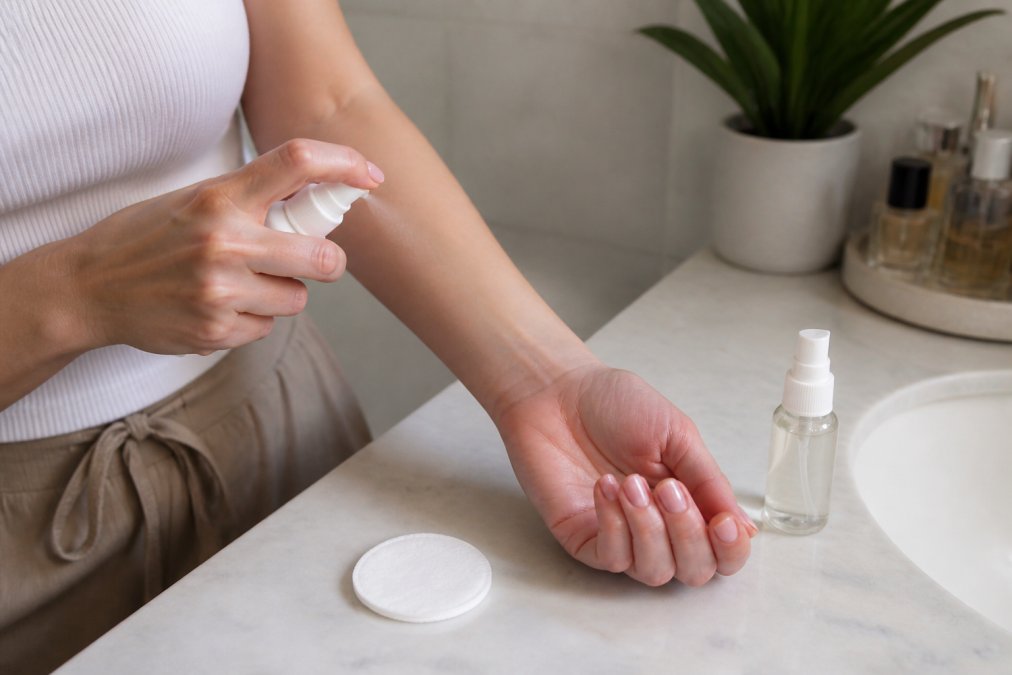
A patch test is the cheapest insurance you can buy: two days and a small patch of skin.
A 48-Hour Patch Test Protocol
Follow this sequence exactly. Do not skip the waiting periods.
Still Standing® Spray - Large →
- Day 1, morning. Clean a small patch on the inside of your forearm or behind your ear. Spray one short burst and let it dry.
- Day 1, evening. Check the patch. Look for redness, bumps, itching, or heat. If any appear, stop and do not use the product.
- Day 2, morning. If the patch is clear, spray a second small burst on the same spot.
- Day 2, evening. Check again. A clear result after two exposures is a good sign your skin tolerates it.
- Day 3, optional. Test on the actual foot, on a small area near the heel, before a full application.
| Step | When | What to Do | What to Watch For |
|---|---|---|---|
| 1 | Day 1 AM | Spray small patch on forearm | Baseline reaction |
| 2 | Day 1 PM | Inspect the patch | Redness, itching, bumps |
| 3 | Day 2 AM | Second small spray | Delayed reaction |
| 4 | Day 2 PM | Final inspection | Heat, swelling, rash |
| 5 | Day 3 | Test on heel area | Tolerance on foot skin |
Best High Heel Pain Relief Without Numbing Your Feet
The best high heel pain relief does not deaden your feet. It reduces the swelling and friction that cause pain, so you keep full sensation and control of your step.
Blister Prevention Spray for Feet: What Actually Works
A blister prevention spray for feet works by cutting friction, not by numbing a spot after a blister has formed. Friction and moisture create blisters, so the spray must address both.
Here is what actually helps:
- Reduce friction at the heel and ball of the foot. These are the two spots where heels rub hardest.
- Control moisture. Damp skin softens and tears more easily.
- Apply before you put the shoes on. A spray applied to a fresh, dry foot creates a smoother surface than one applied mid-event.
- Reapply at the first sign of rubbing. Do not wait for a blister to form.
The Pre-Wear and Post-Wear Protocol Nobody Else Gives You
Most guides stop at "spray your feet." For sensitive skin, the routine around the spray matters as much as the spray itself. Here is the sequence we recommend to brides and long-event wearers.
The night before
- Exfoliate gently. A soft pumice or urea-based cream on the heel removes dead cells that would flake and rub. Skip acids if your skin is already irritated.
- Moisturize, then let it absorb fully. A fragrance-free cream overnight gives the barrier a head start. Skip moisturizer the morning of, it makes the foot slick and the shoe rubs more.
- Break in the shoes. Ten minutes around the house in the actual pair. New shoes and sensitive skin are a bad first date.
The morning of
- Wash and dry completely. Between the toes, around the heel, everywhere. Residual moisture is the enemy.
- Apply the spray to a clean, dry foot and let it dry fully before the shoe goes on, a wet spray is a slip hazard inside a heel.
- Add a friction barrier at the two hot spots. A thin hydrocolloid bandage or moleskin patch on the heel and ball of the foot adds a physical layer the spray cannot provide.
- Powder the inside of the shoe, not the foot, if you tend to sweat. Foot powder on skin can cake and increase friction.
During the event
- Reapply at the first tingle, not the first blister. Once the skin is hot and red, you are past prevention and into damage control.
- Swap shoes if you can. Changing heel height mid-event shifts pressure to different spots and gives hot spots a break.
The moment the shoes come off
- Wash with lukewarm water, not hot. Hot water worsens swelling and irritation.
- Check for hot spots. A red, warm patch that has not blistered can still be saved with a hydrocolloid bandage overnight.
- Elevate for 15 to 20 minutes to bring down swelling.
- Apply a fragrance-free moisturizer, a thick occlusive like petrolatum on angry spots, a lighter cream everywhere else.
- Do not pop anything. A blister is a sterile dressing your body built; popping it invites infection, especially on a foot.
- Give your feet a rest day. Flats or supportive shoes the next day, and skip the spray so the barrier can rebuild.
When to Skip Foot Sprays Entirely
Skip a foot spray if you have broken skin, an open blister, or an active rash on your feet. Topical application on damaged skin absorbs faster and is far more likely to sting or irritate.
Other reasons to hold off:
- You have a known allergy to lidocaine, menthol, or fragrance.
- Your doctor has told you to avoid topical anesthetics.
- You are pregnant or nursing and have not checked with your doctor.
- You have a diagnosed skin condition such as eczema or psoriasis on your feet.
Post-Wear Foot Recovery for Sensitive Skin
Recovery starts the moment the shoes come off and matters most for sensitive skin. The goal: calm the skin, reduce swelling, and let the barrier rebuild overnight.
A simple routine:
- Wash and dry your feet. Remove any spray residue with lukewarm water.
- Elevate for 15 to 20 minutes. This helps with the swelling that builds through a long day.
- Moisturize. A fragrance-free moisturizer supports the skin barrier while it recovers.
- Skip the hot bath. Heat can worsen swelling and irritation.
- Give your feet a rest day. Wear flats or supportive shoes the next day if you can.
Conclusion
Sensitive skin and high heels can coexist if you choose products as carefully as shoes. Patch test first, pick a formula without numbing agents, and treat recovery as part of the routine.
Frequently Asked Questions
What spray can I use to prevent my feet from hurting in heels if I have sensitive skin?
Look for a non-numbing heel spray made without numbing agents, with cooling menthol and plant-derived anti-inflammatory ingredients. Still Standing® Spray is paraben-free, cruelty-free, and designed to support comfort without deadening sensation, which matters for sensitive skin because you keep full feeling in your feet and avoid the fall risk that comes with numbness. Patch test any spray on your forearm 48 hours before an event.
Is it safe to use numbing sprays on feet for long periods?
Numbing sprays contain topical anesthetics like lidocaine. Numb feet can hide the pain signals that tell you a blister or strain is forming, which raises your risk of falling. If you need hours of comfort, a non-numbing formula is the safer choice for extended wear.
How can I prevent blisters in high heels if I have sensitive skin?
Reduce friction first: choose heels that fit without slipping, break them in before the event, and use a blister prevention spray for feet that creates a protective layer rather than a numbing one. Keep the skin barrier intact with a moisturizing formula the night before, since dry skin tears more easily. If a hot spot starts, cover it immediately with a blister bandage instead of pushing through.
What ingredients should sensitive skin avoid in foot sprays?
Watch for high concentrations of lidocaine or benzocaine, added fragrance, alcohol-heavy formulas that sting on broken skin, and preservatives like parabens if you have reacted to them before. Contact dermatitis from topical anesthetics is well documented, so a patch test is your best filter. Formulas that are paraben-free, cruelty-free, and made without numbing agents, like Still Standing® Spray, remove several of the most common triggers.